
WHAT IS A BOILER? LEARN MORE ABOUT BOILERS AND THEIR TYPES.
- Samson Indonesia Boiler

- Jan 13
- 6 min read
A boiler is a vessel used to heat a thermal fluid (usually water or oil) through a combustion system. This process produces a heating medium such as steam, hot water, or hot oil, which is used in various industrial processes that require heat.
A simple example of a boiler can be illustrated by imagining you're cooking boiled chicken for dinner. The boiled chicken is cooked or heated using a pan placed on a gas stove. You turn on the gas to create a flame that then heats the boiled chicken.
Now, how does this example relate to a boiler?
A boiler works similarly to the stove we typically use to cook food, as in the boiled chicken example above. The boiled chicken is likened to the material or product in a factory that needs to be heated. Hot water serves as the medium or thermal fluid. The vessel or container is depicted as the pan. The stove represents the burner, the device the boiler uses to generate heat energy or fire.
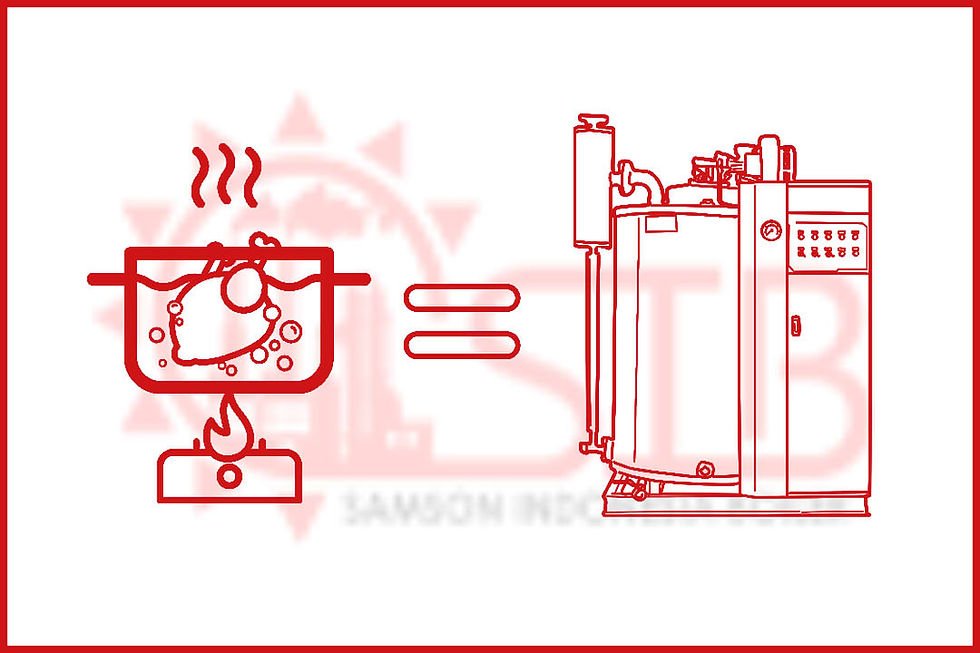
In short, a boiler uses fuels such as gas, biomass, coal, or diesel to produce heat. This heat is then transferred to a thermal fluid (such as water or oil), producing a heating medium (such as hot water, steam, or thermal oil). This medium is then used to heat products or drive processes in industrial environments.
"Why Not Just Use a Stove?"
Interesting question. What if you needed to boil thousands of chickens in a short time? You certainly wouldn't use one stove or buy thousands of them! This is where boilers come into play.
Boilers are capable of efficiently producing large amounts of heat, making them ideal for industrial-scale operations. Whether in food production, chemical processing, or energy generation, boilers provide the high thermal output required by industry. Unlike stoves, boilers utilize multiple combustion processes to increase efficiency and reduce heat loss.
BOILER APPLICATIONS IN INDUSTRY
Boilers are frequently used in industrial and commercial facilities for a variety of heating applications. These industries are very diverse, and here are some sectors that use boilers:
Sector | Utility / function | Example |
Food and beverage (fnb) | Cooking food and beverage products. Also used to facilitate mixing or stirring. | Tofu, Flavored Drinks, Crackers, Snacks, Seasonings, Sauces, and more |
Chemical | Melting chemicals that have frozen due to their high freezing point. The process of mixing chemicals. | Chemicals, Rubber, Plastics, and others |
Powerplant | Operates a turbine wheel to generate electricity. It typically uses high pressure to drive the turbine. | Steam power plants such as PLN |
Hospital | Sterilisasi | Sterile surgical equipment |
Hotel | Provision of hot water, laundry and heating | Hot springs or swimming pools |
Textiles | Coloring, printing, washing process | Fabric, batik, denim |
Laundry | Steam iron | clean clothes |
Crude palm oil (CPO) | Distillation | Palm oil |
Pharmacy | Sterilization and mixing | medicine and medical devices |
BOILER TYPES
Boilers can be categorized into various types and types. Here are some types and types without specific details:
1. Based on thermal medium
a. Steam Boiler
A steam boiler is a boiler machine that uses steam to transfer heat. Steam is very effective as a heat conductor because it can store much more heat energy than water. Furthermore, steam, when under pressure, is also very efficient. The downside is that it requires significant maintenance.
b. Hot Water Heater
This type of boiler uses hot water to transfer heat energy. Unlike steam, water stores much less heat energy, so it only functions when the required heat does not exceed 90°C.
c. Thermal Oil Heater
A thermal oil heater works in a similar way to a hot water heater. However, instead of hot water, a thermal oil heater uses oil as the heating medium. Oil tends to have a very high heat capacity and a very high boiling point. Therefore, without evaporating, the oil can be heated to temperatures up to 350°C. Hot oil heaters require minimal maintenance and have a long lifespan. However, they have a relatively high implementation cost.
2. Based on Position
a. Horizontal Boiler
A horizontal steam boiler is a boiler positioned horizontally. This model generally uses a fire tube system in its engine design, but this is not the case in all cases. This type of boiler is very space-consuming because it requires a large area.
b. Vertical Boiler
A vertical steam boiler is a boiler positioned vertically or upright. All models of this type use a water tube system in their engine design. This type of boiler offers excellent space efficiency because it tends to be small and does not take up much area.
3. Based on the circulation method
a. Forced Drought Boiler
This type of boiler requires an additional pump to push the heat medium. Almost all types of boilers use this type. This type of boiler requires additional equipment such as a pump or blower to push heat to the process engine.
b. Natural Drought Boiler
This type of boiler does not require an additional pump or blower to transfer the heat medium. Steam boilers are the only known type of boiler currently that does not require a pump. This is because steam boilers use pressure to transfer steam from the steam boiler to the process engine.
4. Based on Fuel
a. Solid Fuel
This type of boiler uses solid fuel such as biomass or coal. Biomass itself can be various types, such as wood, wood chips, palm kernel shells, recycled waste, and others. There are many types of combi boilers and chain grates. There is also a new model of wood pellet steam boiler, which is currently one of Samson Indonesia Boiler's best products. Unlike ordinary biomass, wood pellets are a type of wood that has been pressed and dried, resulting in a very high energy and efficiency. The fuel is also much cheaper in terms of transactions and efficiency.
b. Liquid Fuel
This type of boiler is one of the most common types of boilers. It uses liquid fuels such as diesel, biodiesel, or residue.
c. Gas Fuel
This type of boiler uses gas fuel such as LPG (Liquefied Petroleum Gas), CNG (Compressed Natural Gas), LNG (Liquefied Natural Gas), or natural gas distributed by PGN. The operational costs of these gas fuels vary widely depending on the type of gas used.
e. Electric Boiler
This type of boiler is a new type of boiler produced by Samson Indonesia Boiler. Currently, the use of electric boilers is still limited due to the high operational costs associated with large-capacity boilers. Electric boilers are suitable for small-scale applications (highly recommended for UMKM), especially in residential areas, as they do not require a chimney because the fuel is electricity (not combustion).
5. Based on the internal structure
a. Water-tube boiler
These two types are specifically for steam boilers. Water tube boilers are a type of steam boiler where water is heated within tubes. They are generally vertical, but horizontal models are also possible. This type of steam boiler is very safe because it distributes pressure across various tubes. It's no surprise that this type is used in power plants, considering that power plants use high-pressure steam boilers with pressures of 200 bar and above.
b. Fire-tube boiler
This type of boiler heats water in a large tube, and fire or hot air heats the water through tubes that pass through the tube containing the water. This type is commonly used for boilers with a capacity of 12 bar or less due to the high risk. Unlike water tube boilers, this type does not distribute pressure, so if it has a very large capacity and pressure, negligence can cause an explosion that can be fatal. This is where the role of K3 (Occupational Health and Safety) or monitoring by the Kemenaker is crucial. Therefore, steam boilers require a Red Book or permit to operate because it can cause major accidents. Samson Indonesia Boiler can assist in obtaining a steam boiler permit.
6. Based on Pressure
a. High Pressure Boiler
This type of boiler is a steam boiler that operates under very high pressure. As I mentioned, the only boiler currently equipped with a pressurized system is a steam boiler. This type of steam boiler is commonly used in power plants or maritime industries. This type is used not for heating but for power generation, such as driving turbines in power plants and in maritime industries, to drive ship turbines. A steam boiler is categorized as high pressure if it has a pressure above 50 bar.
b. Medium Pressure Boiler
This type of boiler is typically used for heating needs above 200 Celsius. Steam boilers are categorized as medium pressure if they have a pressure above 10 bar and below 50 bar. This model is commonly used in large industries or some iron smelters.
c. Low Pressure Boiler
This type of steam boiler is very commonly used in industry. It is used to extract heat below 200 Celsius. This type has many applications. Due to the low pressure, this steam boiler is considered safe, especially the SSBV type (by Samson Indonesia Boiler), which uses a water tube system. Boilers are categorized as low pressure if the pressure is 10 bar or below.
Now that we have a basic understanding of boilers, there's still much more to explain to fully understand them. We haven't even discussed how they work or the other supporting equipment essential for a smooth boiler operation. Samson Indonesia Boiler has been a boiler expert since 1993, providing the best boiler solutions to advance your business.


Comments