
STEAM BOILER EXPLANATION, APPLICATION, ADVANTAGES & DISADVANTAGES
- Samson Indonesia Boiler

- Jan 16
- 5 min read
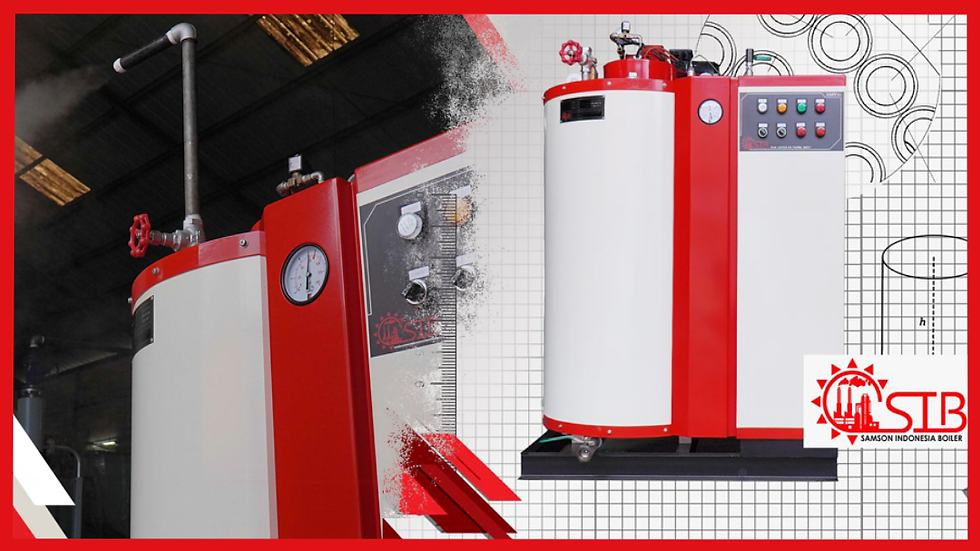
A steam boiler is a machine used to generate steam by heating it. The resulting steam is used as a heat transfer medium. The heat from this steam is then used in the production system.
The capacity of a steam boiler depends on the amount of steam produced. This can range from 50 kg/hour to over 20 tons/hour. So, if a boiler has a capacity of 500 kg/hour, it produces approximately 500 kg of steam per hour.
There are many benefits to using a boiler, but it's important to learn how a steam boiler works.
How does a Steam Boiler work?
Because the steam boiler process is quite lengthy, the explanation is divided into three parts. These three parts are essential for the steam boiler to operate.
1. Feed Water System
Feed water is the water that enters the boiler and is heated. Feedwater will then evaporate after it passes its boiling point. This process connects the water source to the boiler with a feedwater pump. This water will undergo several water cleaning processes called water treatment.
There are two water sources: external and circulating. External sources obtain feedwater from rainwater, rivers, lakes, and other sources.
Circulating sources are water sources drawn from circulating steam that has condensed. After being used, the circulating steam loses its heat energy, causing the steam to condensate back into water. This water has residual heat energy that can be reused to avoid wasting energy. Therefore, the condensed water is fed back into the steam boiler. Steam can be condensed using a device called a condenser.
Water sources need to be demineralized and purified (water treatment*) using mechanical (deaerator) and chemical (water softener) processes. This is crucial for maintaining the durability of steam boilers.
*The importance of water treatment (and how crucial it is if not done)
A brief discussion on this is necessary, as many factories still neglect water treatment. Steam boilers have a fairly long lifespan, but their lifespan cannot last long without the input of very clean water. This clean water can only be achieved through water treatment. Without water treatment, minerals in untreated water can corrode the steam boiler body, causing rust. This not only reduces boiler efficiency but can also be dangerous if the unmaintained steam boiler body explodes.
2. Steam System
This section will discuss the process by which water evaporates and is then delivered to the production system.
Feedwater di simpan di steam boiler. burner (gas/solar) atau Tungku (Batubara/biomass) menghasilkan energi panas. Energi panas ini di kirim ke air meningkatkan suhu air hingga mencapai titik didihnya dan menguap. Proses pemanasan ini di bantu dengan tekanan, sehingga mempercepat proses penguapan. Proses ini juga di kontrol dengan sensor dan elektrik, mengontrol jumlah keluarnya uap, suhu, dan tekanan dari steam boiler.
Setelah itu uap langsung di kirim ke sistem produksi melalui pipa dan valve spesial untuk uap yang bertekanan. Sebenarnya banyak hal lagi yang perlu di pelajari mengenai proses dan hitungan untuk steam boiler, namun sebaiknya pelajaran untuk lain waktu.
3. Fuel System
Bagian ini adalah bagian yang mengontrol masuknya bahan bakar untuk burner atau tungku. Ada 4 jenis bahan bakar yang biasa di gunakan.
1. Solar
2. Gas
3. Dual (Solar & Gas)
4. Batu bara / Biomass
The combustion process produces smoke, which is then expelled through the chimney. For coal/biomass, a smoke purification process is usually carried out to prevent environmental damage.
The smoke still contains heat energy from the combustion residue. This residual heat can be used to preheat the feedwater so that the water is already hot when it enters. This can be achieved using a device called an economizer.
WHY STEAM BOILERS?
Steam contains more energy per kilogram than water.
- Water at 100 degrees Celsius and 1 bar pressure has an energy of approximately 294 kJ/kg.
- Oil at 150 degrees Celsius has an energy of approximately 276 kJ/kg.
- Steam, however, contains 2550.4 kJ/kg at 100 degrees Celsius and 1 bar.
Steam boilers use pressure, so no pumps are needed to deliver steam to the process. The steam is transported by the pressure difference between the boiler and the system.
It can reach high temperatures quickly because it is heated by pressure.
It is not hazardous for food and beverage processes because it uses clean water.
Water itself is an inexpensive medium.
SOME THINGS TO NOTE:
Poor maintenance can be dangerous, given the pressure involved.
It requires higher operational costs. These costs include water treatment, maintenance, labor, and other costs.
A government certificate is required to operate a steam boiler because steam boilers can be dangerous.
Without water treatment, corrosion can occur inside the steam boiler.
APPLICATIONS/USES
1. Hospitals/Pharmaceuticals
Sterilization
Autoclaves
Humidification
2. Food Processing
Bakeries
Jacketed Vessels
Dairy Farms
Breweries
3. Laundry & Dry Cleaning
4. Jacketed Kettles
5. Steam Tunnels
6. Bottling
7. Building Heat
8. Power Plants (Turbines)
Advantages of Steam Boilers
1. High heat energy and rapid heating
Steam carries high heat energy, allowing for faster heating than many local heating methods. This is particularly important for processes requiring rapid temperature increases or high heat loads.
2. Easy distribution to multiple points of use
One boiler can serve multiple machines simultaneously through a steam pipe network. This is convenient for factories with multiple heating points. If additional machines are added, the system is often easier to expand than installing separate heaters per machine.
3. Process temperature control tends to be stable
For saturated steam, steam pressure is directly correlated with temperature. This allows for relatively consistent process control, especially if the control system and PRV station are properly designed.
4. Flexible for various industrial applications
Steam can be used for heating through heat exchangers, jacket tank heating, direct steam injection, sterilization, humidification, and even driving certain equipment, depending on the design.
5. High efficiency potential if the system is right
Efficiency doesn't just come from the boiler, but also from the system itself. With an economizer, condensate return, good pipe insulation, a healthy steam trap, and measured blowdown, the cost per kilogram of steam can be very competitive.
6. Industrial infrastructure and spare parts are relatively commonplace
Steam system components such as valves, steam traps, PRVs, piping, and instruments are commonplace in the industry. This simplifies operational standards, operator training, and component availability.
Disadvantages of Steam Boilers
1. High safety risks due to pressurized equipment
Steam boilers are pressurized equipment. There are potential risks of overpressure, low water, water hammer, and combustion failure. Therefore, a safety system, SOPs, and operational discipline are mandatory.
2. Water treatment is mandatory and non-negotiable
Water is the lifeblood of the boiler. Without water treatment, scale and corrosion will quickly appear. The effects range from fuel waste and decreased performance to tube damage and significant downtime. This also makes monitoring water parameters a routine task.
3. Initial installation costs are higher than for simple heaters
In addition to the boiler unit, numerous supporting systems are required, such as a feedwater tank, pumps, water treatment, blowdown, chimney, steam and condensate piping, steam traps, PRV stations, insulation, and control panels.
4. Steam systems require comprehensive maintenance, not just the boiler unit.
Many costs leak not from the boiler, but from the piping network. Damaged steam traps, poor insulation, leaking valves, and unrecovered condensate are common causes of waste. This means that maintenance must cover the entire network.
5. Efficiency can drop if the load is frequently too small or too fluctuating.
Oversized boilers tend to cycle, switching on and off to meet the set point. This reduces efficiency and causes rapid component wear. The solution is proper sizing, appropriate controls, and a system design that considers the load profile.
6. Dependence on operator quality and procedures
Even a good steam system can still experience problems if operators fail to follow checklists, ignore alarms, or perform blowdown without monitoring. Training and daily logs are essential.


Comments